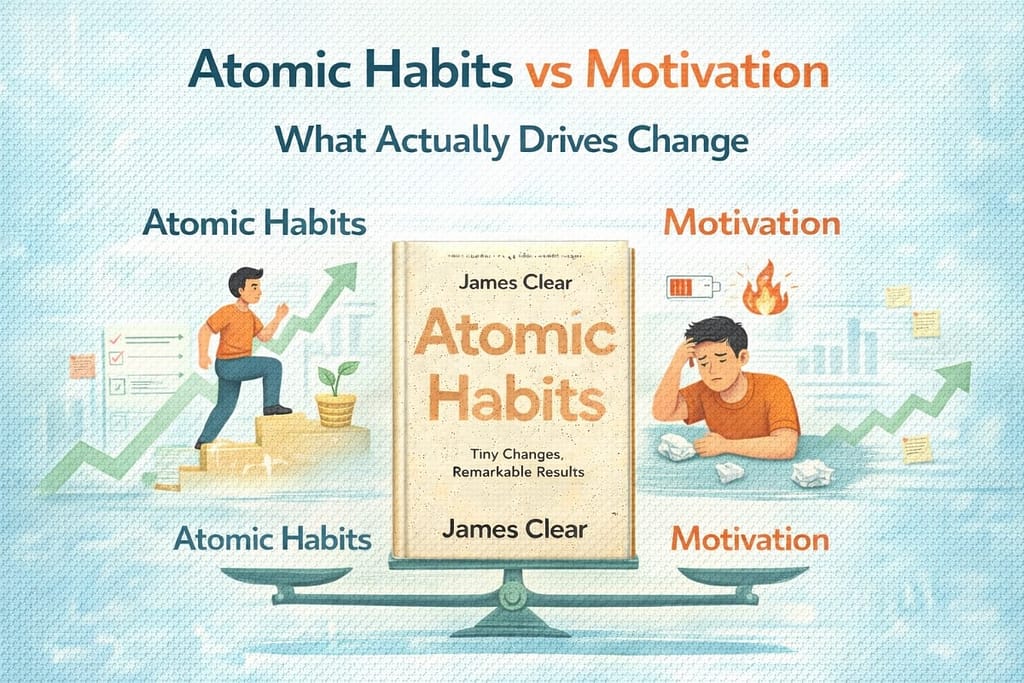
Motivation feels powerful in the moment. When you’re inspired, starting feels easy. But the problem with motivation is that it’s unpredictable—and often short-lived. Most people wait to feel ready before they act, and that’s exactly where progress breaks down.
Atomic Habits takes a very different approach. It explains that real change doesn’t come from emotional highs. It comes from systems that function even when motivation disappears.
This article breaks down what actually drives change—and why relying on motivation alone keeps most people stuck.
Why Atomic Habits vs Motivation Fails to Create Lasting Change
Motivation operates in spikes. One day, you feel energized, focused, and determined. The next day, that feeling is gone.
When habits depend on motivation:
- Action only happens when you feel like it
- Progress becomes inconsistent
- Missed days turn into quitting altogether
That’s why motivation-based approaches collapse under real-life pressure. Stress, fatigue, boredom, and distraction are enough to derail them.
Atomic Habits challenges this idea by removing motivation from the equation entirely.
How Atomic Habits Replaces Motivation with Systems
Atomic Habits works because it doesn’t ask you to wait for inspiration. Instead, it teaches you how to design systems that make action almost automatic.
The book emphasizes:
- Linking habits to clear cues
- Shaping your environment to support action
- Reducing friction so habits are easier to start
When habits are tied to your surroundings instead of your emotions, behavior happens regardless of mood. You don’t need to feel motivated—you just follow the system.
This is why Atomic Habits feels less exciting at first, but far more effective over time.
Systems Stay Stable When Motivation Crashes
Motivation rises and falls. Systems don’t.
A well-designed system continues working:
- On low-energy days
- When enthusiasm fades
- When life gets busy
That stability is what creates long-term change. Progress becomes quiet, consistent, and almost invisible—until results compound. Is Atomic Habits Worth Reading in 2026?
People who rely on motivation often feel productive early on but struggle to maintain momentum. People who rely on systems keep moving forward, even when nothing feels exciting.
What Actually Drives Change
Atomic Habits replaces emotional effort with behavioral consistency. Instead of asking, “How motivated am I today?” the question becomes, “Is my system set up to support this action?”
That shift is what drives real change:
- Structure over inspiration
- Environment over willpower
- Consistency over intensity
When you stop depending on motivation and start depending on systems, progress becomes inevitable.
Frequently Asked Questions
Is motivation useless for building habits?
No, but it’s unreliable. Motivation can help you start, but it can’t sustain long-term behavior on its own.
Why do systems work better than motivation?
Because systems don’t depend on how you feel. They guide behavior automatically through cues and the environment.
Does Atomic Habits eliminate the need for willpower?
It reduces reliance on willpower by making good habits easier to perform and bad habits harder to repeat.
Affiliate Note
Atomic Habits is available on Amazon and Audible if you want to explore the system-based approach in more detail. The Audible version works especially well because the ideas are simple, repeatable, and easy to absorb without heavy note-taking.