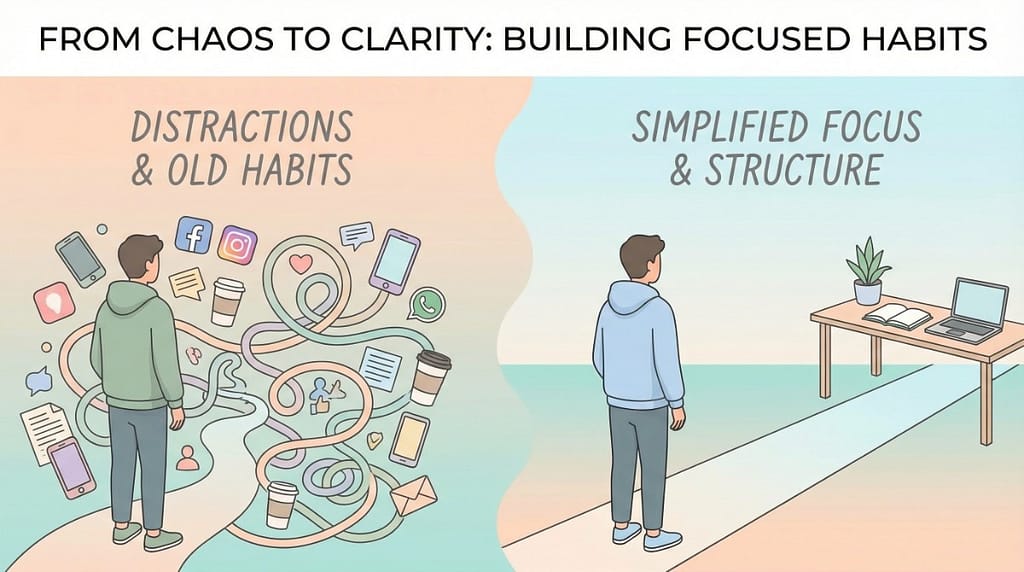
Good advice often sounds obvious. It makes sense when you hear it. You agree with it. You may even feel motivated to act on it. Yet days later, nothing changes. The advice wasn’t wrong—but it still failed.
The reason is simple: behavior follows environment, not intention.
Most advice assumes that once you know what to do, effort will naturally follow. But real life doesn’t work that way. Behavior is shaped by what is easy, visible, and repeatable in your surroundings. When the environment stays the same, even the best advice collapses.
Why Advice Feels Right but Doesn’t Stick
Advice usually targets thinking. It tells you what to do and why it matters. What it often ignores is where the behavior will actually happen.
Your environment constantly sends signals:
- What grabs your attention
- What feels convenient
- What gets rewarded automatically
When those signals support old habits, new ideas struggle to survive. Willpower has to fight friction every day—and willpower eventually loses.
This is why people blame themselves instead of questioning their setup.
How Behavior Environment Determines Outcomes
Behavior doesn’t fail because people are lazy. It fails because the environment makes the wrong actions easier than the right ones.
If unhealthy food is visible, eating well requires effort.
If distractions are always present, focus becomes exhausting.
If routines aren’t supported, consistency disappears.
Advice that ignores the environment places responsibility entirely on the individual. But behavior is a system outcome, not a character trait.
Change sticks when the environment is redesigned to support it.
Willpower Is the Wrong Strategy
Relying on willpower assumes you’ll always feel strong, focused, and disciplined. That assumption breaks quickly.
Good systems remove the need for constant self-control. They make desired behavior the default option rather than the difficult one.
This is why many people follow advice for a few days and then stop. The idea was correct, but the setup was hostile.
This same principle is explored in Why Motivation Dies After Week One, where habits collapse because emotion fades and structure never existed.
Redesigning the Environment
Effective change starts by adjusting surroundings, not motivation.
Small environmental shifts can produce outsized results:
- Making cues visible
- Removing friction from good habits
- Adding friction to bad ones
- Structuring routines around existing behavior
When the environment supports the action, consistency feels natural instead of forced.
Advice finally works when it stops fighting context and starts using it.
Stop Blaming Yourself
When advice fails, people often conclude they lack discipline. That belief keeps them stuck.
The better question is:
- What in my environment is reinforcing the old behavior?
Once that’s addressed, advice becomes practical instead of theoretical. Progress becomes repeatable instead of emotional.
Advice doesn’t fail because it’s wrong. It fails because it’s incomplete without environmental support.
Making Advice Actionable
Advice works when it’s paired with environmental design.
The goal isn’t to try harder. It’s to make the right action easier than the wrong one. When that happens, behavior changes without relying on motivation.
Real change feels boring, not heroic. And that’s exactly why it lasts.
FAQs
Why does good advice fail so often?
Because it ignores the environment that shapes behavior.
Is willpower useless then?
Willpower helps temporarily, but environment determines consistency.
How can I make advice actually work?
By redesigning your surroundings to support the behavior you want.
Affiliate Note
Atomic Habits is available on Amazon (USA) and Amazon (India) in multiple formats, including audiobook, Kindle, and print. The audiobook works particularly well because the ideas focus on systems and environment design, benefiting from repeated listening rather than active note-taking.