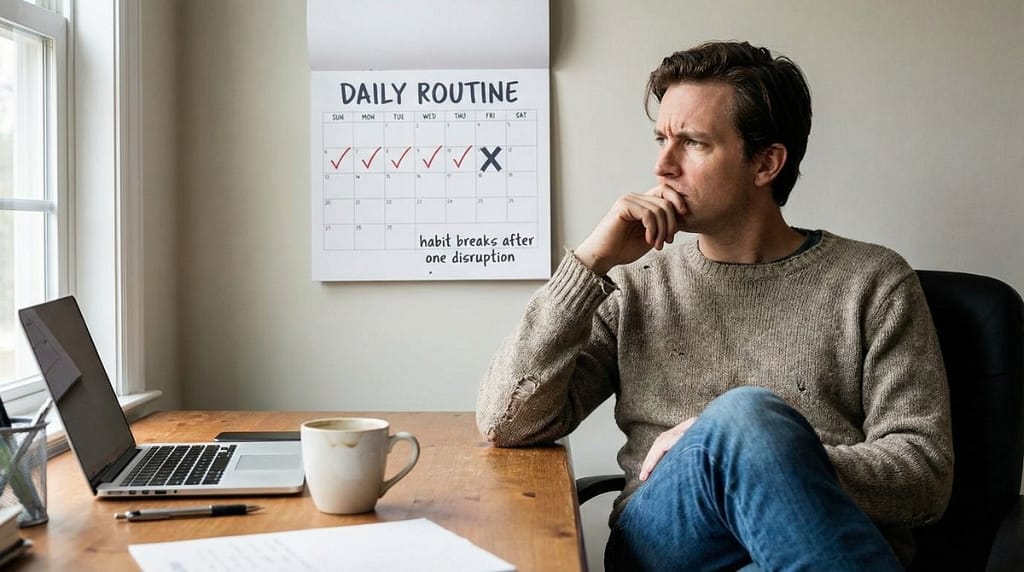
Most habit advice works perfectly—until life happens.
Plans look strong when days are calm and predictable. You sleep on time. You wake up fresh. You follow the routine exactly as designed. Everything feels aligned.
But real life interrupts everything.
You get sick.
You travel.
You miss one day.
You lose momentum.
And suddenly, the habit disappears.
This is why habit advice breaks after the first disruption. It assumes ideal conditions instead of building resilient systems.
Why Most Habit Advice Feels Effective at First
Habit advice often focuses on structure, discipline, and consistency. It encourages streaks, daily tracking, and rigid routines.
In stable conditions, this works.
The problem is that stability doesn’t last. Life isn’t a straight line. Energy fluctuates. Schedules change. Unexpected events appear.
When habit systems are built around perfect execution, they collapse the moment perfection disappears.
That’s not a discipline failure. It’s a design flaw.
When Habit Advice Breaks Under Pressure
Advice fails when it depends on uninterrupted momentum.
If missing one day destroys the entire system, it wasn’t a system. It was a streak.
Streaks rely on continuity without interruption. Systems rely on recovery.
Strong habits are not designed to avoid disruption. They are designed to survive it.
This is closely related to Why Productivity Advice Breaks Down in Real Life, where plans collapse because they weren’t built for messy conditions.
The Problem With Perfect-Condition Planning
Many habit frameworks assume:
- You’ll always sleep properly
- You’ll always have time
- You’ll always feel capable
- You’ll never get sick or travel
That assumption quietly sets you up for failure.
When disruption happens, people interpret it as personal weakness. In reality, the habit was never built to handle disruption in the first place.
Resilient systems expect interruption.
The Difference Between a Streak and a System
A streak focuses on daily perfection.
A system focuses on long-term continuity.
A streak says:
“Don’t miss.”
A system says:
“Restart quickly.”
That difference changes everything.
If a habit collapses after one bad day, it was never a system. It was a fragile structure dependent on ideal conditions.
Real systems include:
- Flexible minimum versions
- Easy restart rules
- Forgiveness built in
- Low recovery cost
Designing Habits That Survive Reality
Resilient habits answer a simple question:
What happens when I miss a day?
If the answer is guilt, frustration, and abandonment, the system is weak.
If the answer is:
- “I resume tomorrow.”
- “I do a smaller version.”
- “I adjust and continue.”
Then the system is strong.
Strong habits don’t panic when life interrupts. They adapt.
Why Disruption Is the Real Test
Anyone can follow a plan during calm periods.
The real test of habit strength appears under:
- Travel
- Illness
- Stress
- Fatigue
- Schedule changes
If the behavior survives those moments, it’s a system. If it disappears, it was temporary momentum disguised as discipline.
Habits that depend on perfect conditions will always break.
Habits designed for disruption endure.
FAQs
Why do habits disappear after one missed day?
Because they were built as streaks, not resilient systems.
Is missing one day really a big deal?
Not if the habit includes a clear restart rule.
How do I build habits that survive disruption?
Design flexible minimum actions and make restarting simple.
Affiliate Note
Atomic Habits is available on Amazon (USA) and Amazon (India) in multiple formats, including audiobook, Kindle, and print. It fits here because it emphasizes system design over motivation and helps build habits that survive disruption.