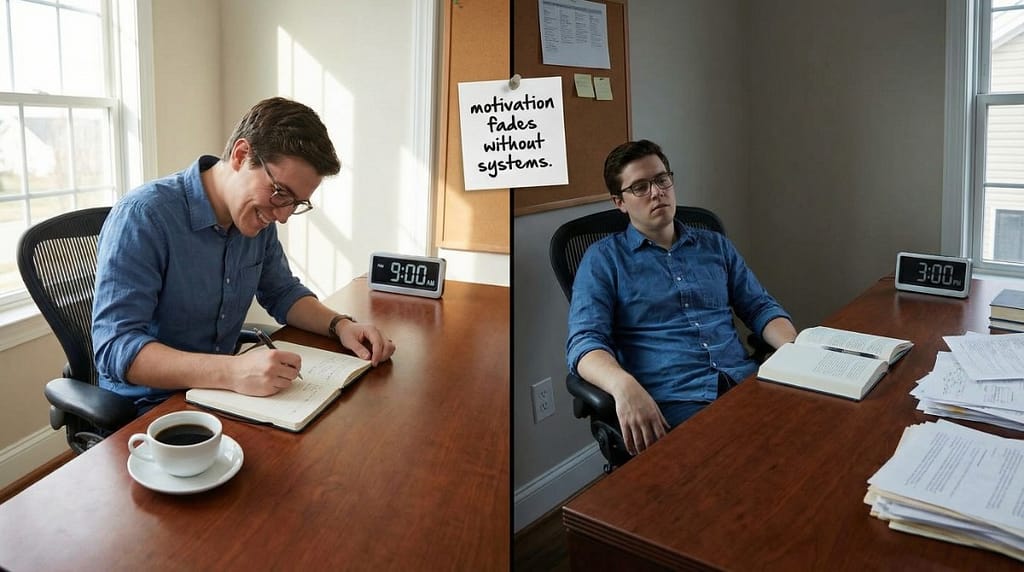
Motivation feels powerful in the moment.
When it appears, action feels easy. Energy rises. Plans feel possible. You start strong, convinced that this time will be different.
But motivation has one major limitation: it has no memory.
It doesn’t show up because you felt inspired yesterday. It only appears when conditions feel right today. That’s why people begin with intensity and then disappear after a few days.
Motivation creates movement, but it doesn’t create stability.
Why Motivation Feels Reliable at First
In the beginning, motivation feels like the perfect engine. It pushes you forward without resistance. You don’t need discipline because enthusiasm carries the effort.
The problem is that motivation depends on emotion.
When energy drops, schedules change, or stress increases, motivation disappears without warning. The behavior that depended on it disappears too.
This creates a familiar cycle:
- Strong start
- Early progress
- Energy dip
- Inconsistent action
- Abandonment
The issue isn’t commitment. The issue is relying on something unstable.
Why Motivation Has No Memory
Motivation doesn’t accumulate over time.
You can’t “store” it for tomorrow. Yesterday’s inspiration doesn’t automatically generate today’s effort. Every day starts fresh.
That’s why motivation feels unpredictable. It responds to mood, environment, and circumstances—not long-term goals.
People often assume they lost discipline when motivation fades. In reality, motivation simply did what it always does: appear temporarily and disappear when conditions shift.
This pattern is closely related to Why Motivation Dies After Week One, where emotional energy fades because structure was never built to replace it.
Movement vs Stability
Motivation excels at creating movement. It helps you begin and progress faster.
But lasting progress requires stability. Stability comes from routines that continue even when motivation is absent.
When behavior depends on how you feel:
- Action becomes inconsistent
- Progress resets repeatedly
- Results stay temporary
When behavior is embedded into routine:
- Action becomes automatic
- Energy matters less
- Consistency survives bad days
Systems remember what motivation forgets.
How Systems Replace Motivation
A system doesn’t ask how you feel before action begins.
It reduces decisions. It simplifies starting. It turns behavior into a default rather than a choice.
Examples include:
- A fixed time for a routine
- Environment designed to remove friction
- Small actions that require minimal energy
- Clear triggers that start behavior automatically
When structure exists, motivation becomes optional instead of necessary.
Building Progress That Doesn’t Depend on Feelings
The goal isn’t to eliminate motivation. It’s to stop relying on it.
Motivation can start a behavior. Systems must carry it forward.
Ask yourself:
- What happens when my energy drops?
- Can this routine continue on a bad day?
- Does action require enthusiasm to begin?
If the answer is yes, progress will remain fragile.
Long-term improvement comes from behaviors that survive low-energy moments, not just inspired ones.
What Real Consistency Looks Like
Consistency often looks boring.
It doesn’t feel powerful. It doesn’t feel inspired. It simply continues.
That continuation is what creates compounding results.
If your progress depends on how motivated you feel, it will always be temporary. If it depends on your environment and routine, it becomes reliable.
Motivation starts the journey. Systems make sure you stay on it.
FAQs
Why does motivation disappear so quickly?
Because it depends on emotion and changing conditions rather than routine.
Is motivation useless then?
No. It’s useful for starting, but not for sustaining progress.
What replaces motivation long term?
Systems that reduce friction and make action automatic.
Affiliate Note
Atomic Habits is available on Amazon (USA) and Amazon (India) in multiple formats, including audiobook, Kindle, and print. It fits this topic because it focuses on systems and environmental design that sustain behavior beyond temporary motivation.