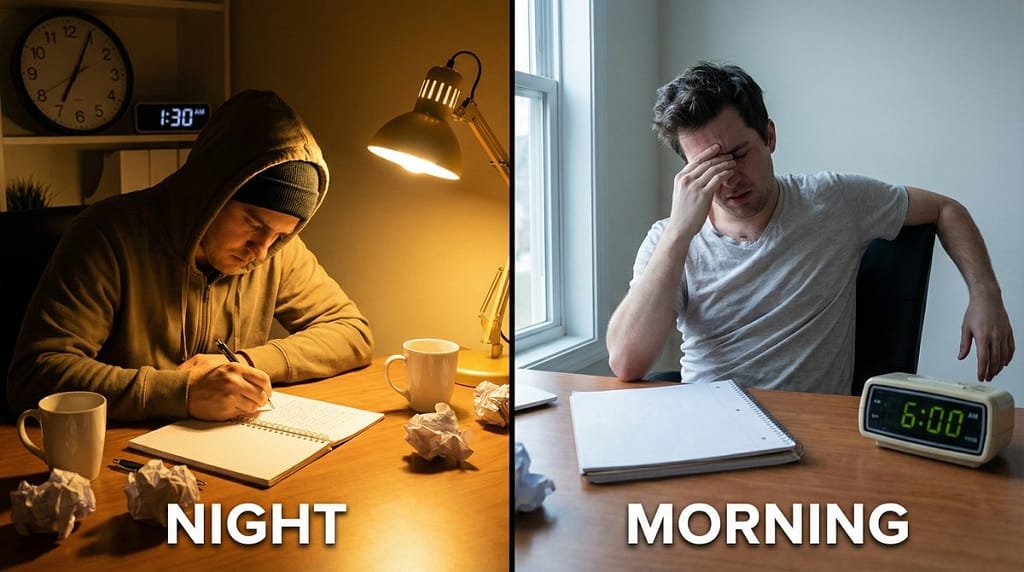
You feel powerful at night.
You plan everything. A new routine. New goals. A fresh start tomorrow. The clarity feels real. You imagine waking up early, working with focus, finally executing.
Then morning comes — and nothing happens.
This pattern isn’t about weak discipline. It’s about nighttime motivation.
Why Nighttime Motivation Feels So Strong
At night, there’s no resistance yet. No friction. No fatigue. No real-world constraints. You’re designing a version of tomorrow that exists only in imagination.
Planning feels safe because it requires no execution.
Your brain also tends to be more reflective at night. You evaluate your day, see gaps, and feel urgency to improve. That urgency creates emotional momentum — but it’s theoretical.
Nighttime motivation is fantasy-friendly. Morning demands reality.
A similar dynamic appears in Why You Keep Quitting After 3 Days, where excitement creates intensity but collapses under friction. The issue isn’t ambition — it’s sustainability.
Why Morning Exposes the Flaw
Morning introduces friction immediately.
Energy is lower than expected. Sleep may not have been perfect. Notifications begin. Responsibilities appear. The abstract plan now requires effort.
Plans designed in comfort rarely survive discomfort.
When you build a system based on how you feel at night, you’re overestimating future energy. You’re designing for inspiration, not for fatigue.
And when the plan collapses, you blame yourself.
But the problem isn’t discipline. It’s when and how you designed the system.
Design for Your Lowest-Energy State
If you want change, design it when you’re tired — not when you’re inspired.
Ask yourself:
What would I realistically do tomorrow morning with half the energy I’m imagining?
Shrink the plan. Reduce the scope. Remove optional steps.
Instead of planning a 90-minute deep work session, commit to 20 focused minutes. Instead of a full routine overhaul, start with one visible action.
The goal isn’t to create a perfect tomorrow at night. It’s to create a doable tomorrow in the morning.
When your system survives low-energy states, motivation becomes optional.
Nighttime inspiration feels powerful. But progress belongs to plans that endure reality.
FAQs
Q1: Why do I always feel more motivated at night?
Because there’s no immediate friction. Planning feels safe when action isn’t required.
Q2: How can I make my morning plans stick?
Design smaller actions that account for lower energy and real-world resistance.
Q3: Should I stop planning at night?
Not necessarily. But test your plans against your lowest-energy state before committing.
Affiliate Note:
Make Time by Jake Knapp and John Zeratsky focuses on designing realistic daily systems that survive distraction and low energy. It’s available on Amazon (USA) and Amazon (India) in audiobook, Kindle, and print formats — reinforcing execution over inspiration.