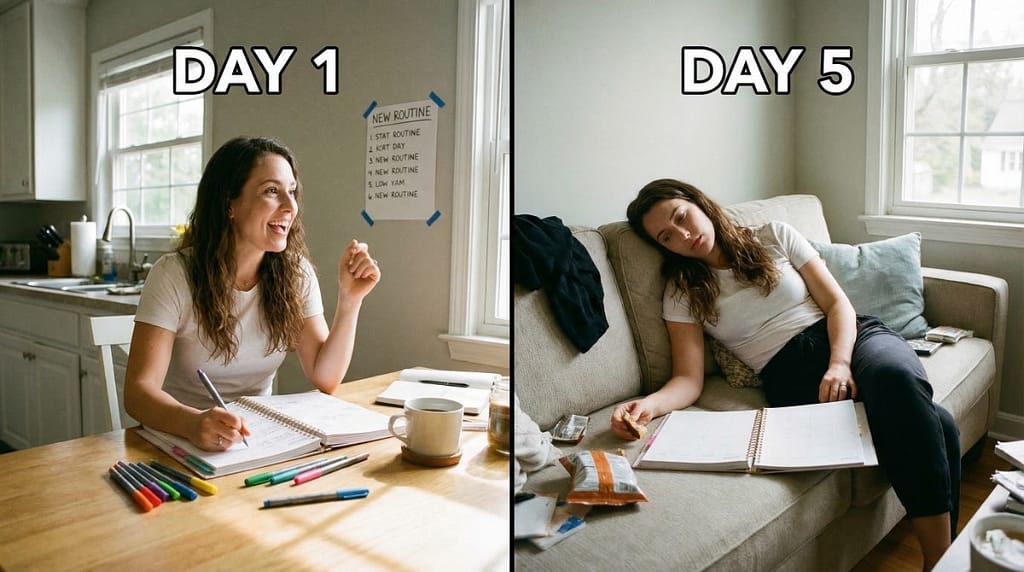
You decide to change your life.
You feel motivated, make a plan, and promise yourself that this time will be different. The decision feels real. The energy feels strong. For a moment, everything seems possible.
But after a few days, the motivation disappears.
What makes this confusing is that you still want the result. You still care about the goal. Yet your actions slow down, the routine breaks, and the plan starts to fade.
This is why many people lose motivation even when they genuinely want to change.
Why You Lose Motivation After a Few Days
Motivation is based on emotion.
When you feel inspired, your brain produces energy quickly. You imagine a better future, and that imagination creates excitement. Starting feels easy because the emotional reward is high.
But emotions don’t stay the same.
As the routine becomes familiar, the excitement fades. The brain stops treating the goal as something new, and the emotional push disappears. When that happens, the same actions suddenly feel harder.
Nothing about the goal changed.
Only the feeling changed.
This is similar to Why Motivation Feels Strong at the Start but Disappears Later, where novelty creates energy but repetition removes it.
Motivation is powerful at the beginning, but unreliable over time.
Why Wanting Change Is Not Enough
Many people think that strong desire should be enough to stay consistent.
But the brain doesn’t work that way.
The brain prefers comfort and familiarity. When a new habit feels difficult or uncomfortable, the mind tries to return to what feels normal. Even if you want the result, the process may still feel unpleasant.
That’s why you can want change and still avoid the work.
Desire comes from thinking about the future.
Resistance comes from feeling the effort in the present.
When emotion fades, the brain chooses what feels easier right now, not what looks better later.
Real Change Happens Without Motivation
The mistake most people make is waiting to feel motivated again.
They stop the habit, hoping the feeling will return. When motivation comes back, they start again. When it fades, they stop again.
This creates a cycle of starting and quitting.
Real change begins when action no longer depends on emotion.
Instead of asking, “Do I feel motivated?” ask, “What is the next small step I can do anyway?”
Reduce the size of the habit. Make the action simple. Repeat it even on low-energy days.
Consistency grows when the behavior survives without excitement.
Motivation can start change, but it cannot finish it.
Progress happens when you keep going even when the feeling is gone.
FAQs
Q1: Why do I lose motivation so quickly?
Because motivation is emotional energy, and emotions naturally rise and fall.
Q2: How can I stay consistent without motivation?
Use small habits and routines that are easy to repeat even on low-energy days.
Q3: Is it normal to want change but not feel motivated?
Yes. Desire and motivation are different. You can want a result even when the process feels difficult.
Affiliate Note:
Atomic Habits explains how lasting change comes from systems, not motivation. It’s available on Amazon (USA) and Amazon (India) in audiobook, Kindle, and print formats — showing how small repeated actions work even when motivation fades.