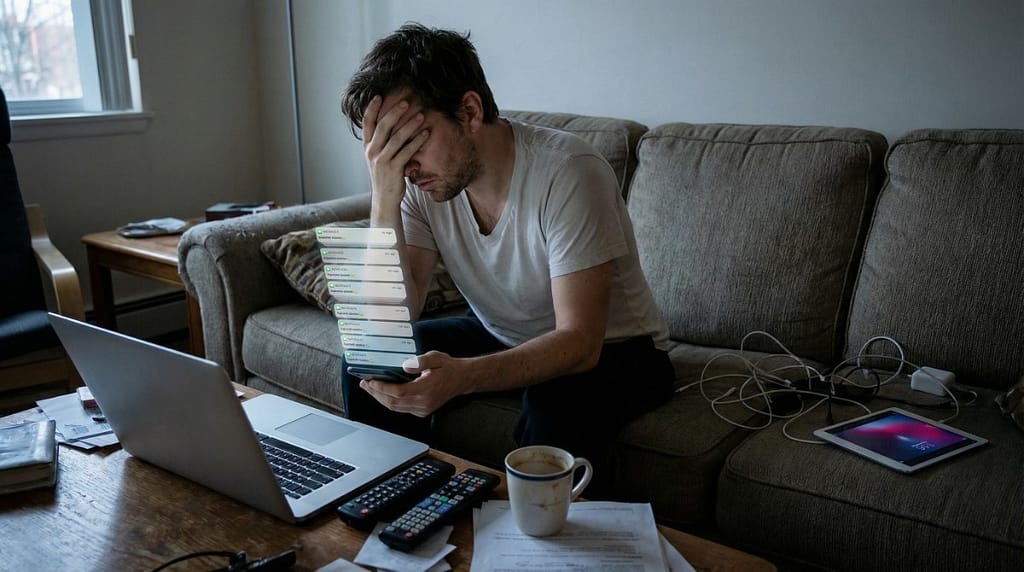
You feel tired all the time.
Even when you didn’t work much. Even when your day wasn’t physically demanding. The tiredness is not in your body — it’s in your mind.
You wake up tired.
You work tired.
You go to sleep tired.
This is not always about lack of sleep.
It is often about overload.
Why You Feel Tired Without Doing Much
Your brain is constantly active.
Scrolling, notifications, switching tasks, thinking, planning — your attention keeps moving all day. Each small activity uses mental energy, even if it doesn’t feel like work.
The problem is not effort.
The problem is constant stimulation.
When your brain never gets a break, it stays in a low-level state of activity all the time. This drains energy slowly but continuously.
This is similar to Why You Feel Mentally Tired All The Time, where constant input prevents the brain from resting properly.
You are not resting.
You are just changing the type of activity.
Stop Overstimulating Your Brain
Too much input creates fatigue.
Endless scrolling, videos, notifications, and random information overload your mind. Each piece may seem small, but together they exhaust your attention.
The brain is not designed to process nonstop stimulation.
When you reduce input, your energy improves.
This doesn’t require extreme changes.
Just reduce one source of noise:
- less scrolling
- fewer notifications
- fewer unnecessary inputs
Small reduction creates noticeable relief.
Create Silence for Your Brain
Your brain needs quiet time.
Not sleep. Not distraction.
Actual silence.
No phone.
No noise.
No input.
Even 10 minutes of silence can help your brain reset.
At first, it may feel uncomfortable. Your mind is used to constant stimulation, so silence feels unfamiliar.
But this is where recovery begins.
When the brain slows down, it restores energy.
Focus on One Task at a Time
Multitasking drains energy.
Switching between tasks forces your brain to restart focus again and again. This uses more mental effort than working on one thing continuously.
Single-tasking reduces that load.
Do one task.
Finish it or move forward clearly.
Then switch.
In Deep Work, Cal Newport explains that constant distraction weakens your ability to focus. When focus becomes weak, even simple tasks feel tiring.
But when attention stays on one task, the brain works more efficiently.
Energy is preserved instead of wasted.
You Are Not Tired. You Are Overloaded
Most people think they need more rest.
In reality, they need less noise.
You don’t need more motivation.
You don’t need a perfect routine.
You need fewer inputs, more silence, and clearer focus.
When the brain stops processing constant stimulation, energy slowly returns.
You don’t feel tired because you are doing too much.
You feel tired because your mind never stops.
FAQs
Q1: Why do I feel tired even when I don’t work much?
Because constant stimulation keeps your brain active all day.
Q2: Can reducing screen time improve energy?
Yes. Less stimulation allows the brain to rest and recover.
Q3: Is multitasking causing my tiredness?
Yes. Frequent task switching drains mental energy.
Affiliate Note
Deep Work by Cal Newport explains how reducing distraction improves focus and mental energy. It’s available on Amazon (USA) and Amazon (India) in audiobook, Kindle, and print formats, and it clearly shows how to reduce mental overload.