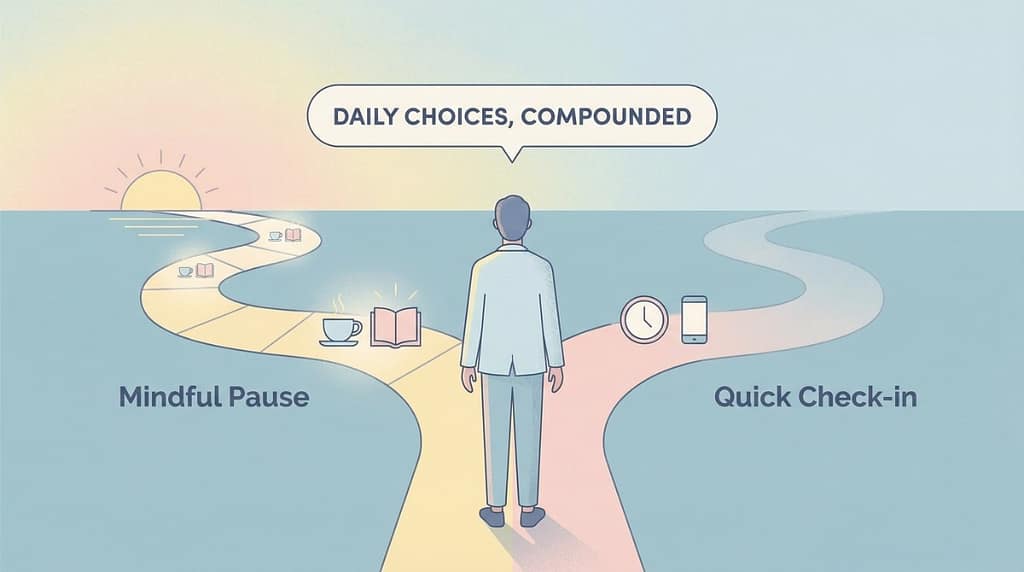
A book’s real test isn’t how insightful it sounds. It’s whether it changes a daily decision.
Many books feel profound while you’re reading them. The language is sharp. The ideas resonate. You feel clearer than before. But days later, nothing in your life looks different. Your schedule is the same. Your routines haven’t shifted. Your choices follow old patterns.
When that happens, the book didn’t fail. It simply stayed theoretical.
Knowledge without behavioral change has no leverage.
Why Insight Alone Doesn’t Create Change
Insight explains problems. It gives names to patterns. It helps you understand why things aren’t working.
But understanding doesn’t automatically alter behavior.
Behavior is driven by decisions made repeatedly:
- What you start
- What you avoid
- What you remove
- What you keep doing even when it’s inconvenient
If a book doesn’t influence those decisions, its impact ends when the reading ends.
This is why people feel informed but unchanged.
Daily Decisions Are the Real Test
A book starts working only when it interferes with your default choices.
Real value appears when:
- You schedule something differently
- You say no more easily
- You remove unnecessary actions
- You choose the simpler option automatically
These shifts don’t feel dramatic. They feel subtle. But over time, they compound.
If nothing changes at the decision level, the book remains an idea—not a tool.
Where Most Books Get Stuck
Many books aim to upgrade mindset without touching structure.
They focus on:
- Thinking better
- Wanting change more
- Feeling inspired
But decisions are rarely made at the level of inspiration. They’re made under time pressure, fatigue, and distraction.
If a book doesn’t survive those conditions, it won’t change behavior.
This is why books that ignore systems and routines struggle to produce results. And it’s closely related to Why Good Advice Fails Without the Right Environment, where ideas collapse because context stays the same.
When Decisions Start Changing Automatically
The strongest books don’t rely on motivation. They redesign choice architecture.
They make the right decision easier than the wrong one. Over time, action becomes automatic rather than negotiated.
This is where leverage appears:
- Less friction
- Fewer decisions
- More consistency
When decisions start changing without conscious effort, behavior follows naturally.
What to Look for While Reading
You don’t need to finish a book to know if it’s working.
Ask yourself:
- What decision is this supposed to change?
- Where will this show up in my day?
- What will I remove because of this idea?
If answers stay abstract, pause. Don’t keep consuming. Application matters more than completion.
Books That Actually Change You
Books don’t change people. Decisions do.
The right book interferes with your defaults. It changes how you choose under pressure. It simplifies action instead of adding complexity.
If a book doesn’t reach that level, it might be interesting—but it won’t be transformative.
Real change begins when reading reshapes daily decisions, not when insight feels satisfying.
FAQs
Why don’t most books lead to behavior change?
Because they focus on insight instead of altering daily decisions and routines.
How can I tell if a book is working?
If your choices start changing automatically, the book is working.
Should I stop reading if nothing changes?
Pause reading and apply one idea before consuming more.
Affiliate Note
Atomic Habits is available on Amazon (USA) and Amazon (India) in multiple formats, including audiobook, Kindle, and print. The audiobook works particularly well because the ideas focus on small decisions and systems that benefit from repeated listening rather than active note-taking.