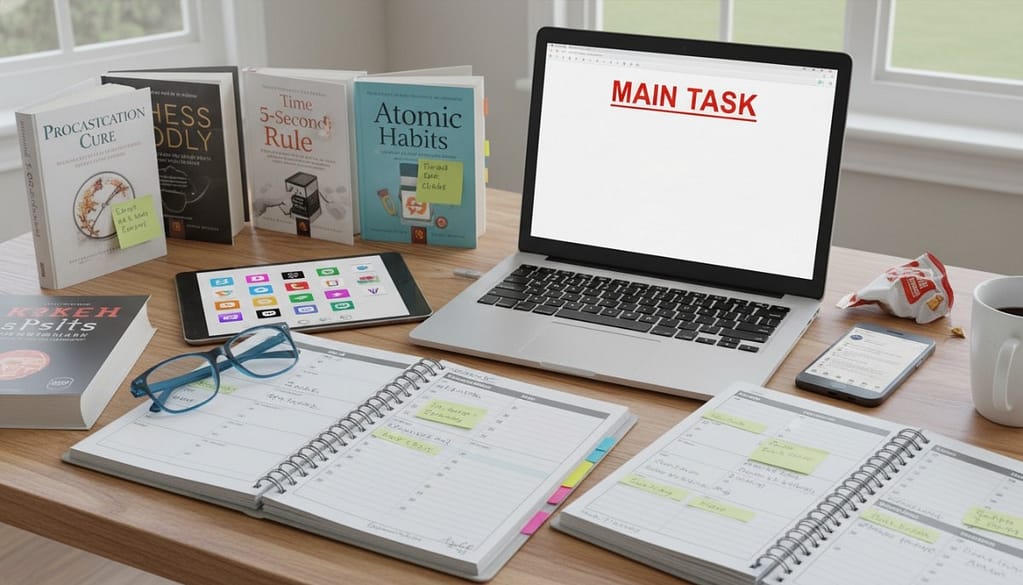
Self-improvement might be your favorite form of procrastination.
You don’t waste hours on games or Netflix. You waste time upgrading yourself. A new book. A new routine. A new productivity system. It feels responsible. It feels ambitious. It feels like growth.
But your output hasn’t changed.
This is the subtle trap of self-improvement procrastination. It disguises avoidance as ambition. You believe you’re moving forward because everything you consume is “better than before.” But execution remains inconsistent.
Planning feels safer than performing. Research feels smarter than risking failure.
So you stay in preparation mode.
Why Self-Improvement Procrastination Feels Productive
Preparation provides psychological comfort. When you refine a system or explore a new framework, you feel proactive. You’re doing something related to your goals.
But there’s a difference between designing work and doing work.
The mind prefers low-risk activity. Reading about execution is safer than executing. Watching tutorials feels constructive without exposing you to mistakes. Optimizing tools creates the illusion of control.
This pattern overlaps with You’re Addicted to Improvement, where novelty replaces repetition and constant upgrading prevents mastery.
When you’re constantly refining your system, you rarely test it long enough to see results.
The Safety of Preparation Mode
Preparation mode protects identity.
If you never fully commit to action, you never fully risk failure. You can always say, “I’m still setting things up.” Or, “I’m finding a better method.”
But real progress requires exposure. It requires visible attempts. It requires repetition that feels boring and sometimes frustrating.
Self-improvement procrastination avoids that discomfort.
It keeps you intellectually engaged but behaviorally stagnant.
The irony is that you may look disciplined from the outside. You’re reading, organizing, planning. Yet the core work — the one task that actually moves the needle — remains postponed.
Stop Optimizing. Start Repeating.
The solution is not to abandon self-improvement. It’s to cap it.
Choose one system. One routine. One approach. Then commit to repetition before revision.
Instead of asking, “How can I improve this?” ask, “Have I repeated this long enough to judge it?”
Real growth begins when you stop redesigning your workflow every week and start executing within it consistently.
If you’re constantly improving your system, you might be avoiding the work itself.
Progress doesn’t come from perfect preparation. It comes from imperfect repetition.
FAQs
Q1: How do I know if self-improvement is becoming procrastination?
If you spend more time planning and refining than executing core tasks, improvement may be replacing action.
Q2: Should I stop learning altogether?
No. Limit learning periods and prioritize execution cycles before consuming more input.
Q3: How long should I stick with one system?
Long enough to test it consistently — typically 30–90 days before making major adjustments.
Affiliate Note:
The ONE Thing emphasizes narrowing focus to the single task that creates disproportionate results instead of endlessly refining systems. It’s available on Amazon (USA) and Amazon (India) in audiobook, Kindle, and print formats — reinforcing execution over optimization.