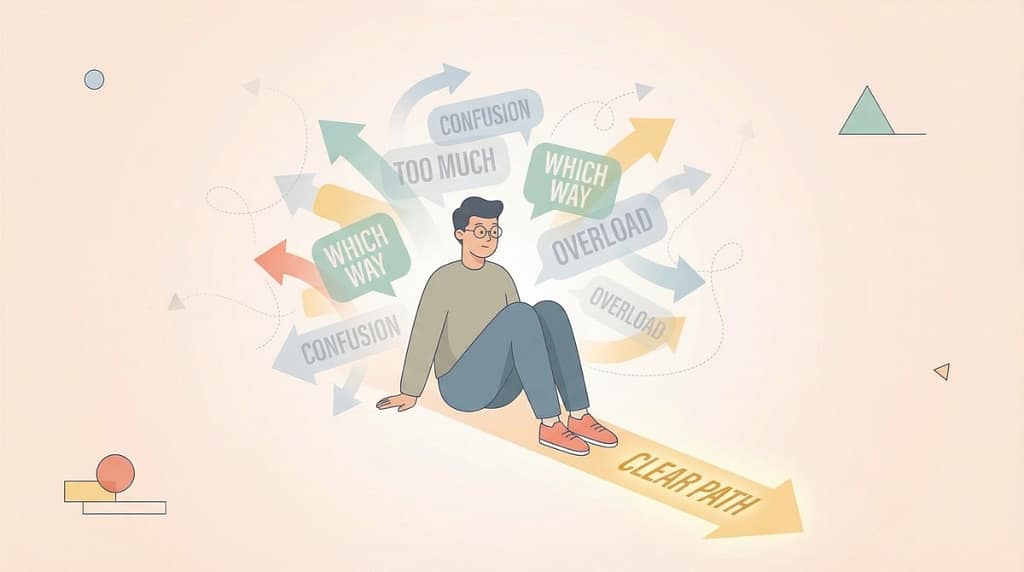
Advice is everywhere. Books, videos, threads, podcasts—each offering a better way to think, work, or live. On its own, advice feels helpful. But when too much advice accumulates, it stops clarifying and starts confusing. This is the hidden cost of advice overload.
Each new idea competes for attention. Each framework asks for commitment. Over time, execution weakens—not because advice is bad, but because there’s too much of it.
When everything feels important, nothing actually gets done.
Why More Advice Creates Less Progress
Advice promises improvement, but it also introduces choice.
Every new suggestion adds another option, another priority, another thing you should be doing. The result isn’t clarity—it’s cognitive noise. You spend more time deciding than acting.
Instead of reinforcing one direction, advice pulls attention in multiple directions. Execution becomes diluted. Effort spreads thin.
Progress requires focus. Advice overload destroys it.
Advice Overload Dilutes Execution
Execution depends on commitment. Advice overload undermines commitment by constantly reopening decisions.
When you keep adding ideas:
- You delay starting
- You second-guess existing routines
- You abandon systems too early
Nothing stays in place long enough to work.
This is why people feel busy applying “good advice” yet see no results. They’re switching paths too often to build momentum.
This pattern also shows up in The Difference Between Busy and Effective, where activity increases but impact stays low because effort lacks direction.
When Everything Matters, Nothing Moves
Advice overload creates a dangerous illusion: the belief that more information equals better outcomes.
But progress isn’t additive. It’s selective.
Real improvement requires choosing:
- What to follow
- What to delay
- What to ignore entirely
Ignoring advice feels uncomfortable. It feels like missing out. But without exclusion, nothing compounds.
Clarity comes from subtraction.
The Cost You Don’t See
The real cost of following too much advice isn’t confusion alone—it’s stalled results.
Scattered effort prevents feedback. Without repetition, you can’t tell what works. Without consistency, nothing compounds.
Advice overload keeps you permanently in “learning mode” and never in “building mode.”
That’s why progress feels slow even when effort feels high.
Choosing What to Ignore
Progress accelerates when input decreases.
This means committing to fewer ideas and applying them longer. It means resisting the urge to upgrade systems prematurely. It means letting good advice wait while one idea proves itself.
The most effective people aren’t those with the most advice. They’re the ones who choose what to ignore.
From Consumption to Commitment
Advice is valuable only when it leads to action.
If your current stack of ideas isn’t changing behavior, the solution isn’t better advice—it’s fewer inputs and stronger execution.
Choosing less doesn’t limit growth. It enables it.
FAQs
Why does too much advice slow progress?
Because it competes for attention and prevents consistent execution.
Is advice overload the same as information overload?
Related, but advice overload specifically disrupts decision-making and action.
How can I avoid advice overload?
Commit to one idea at a time and ignore new inputs until results appear.
Affiliate Note
Essentialism is available on Amazon (USA) and Amazon (India) in multiple formats, including audiobook, Kindle, and print. The audiobook works particularly well because its ideas focus on deliberate subtraction and prioritization, benefiting from repeated listening rather than active note-taking.