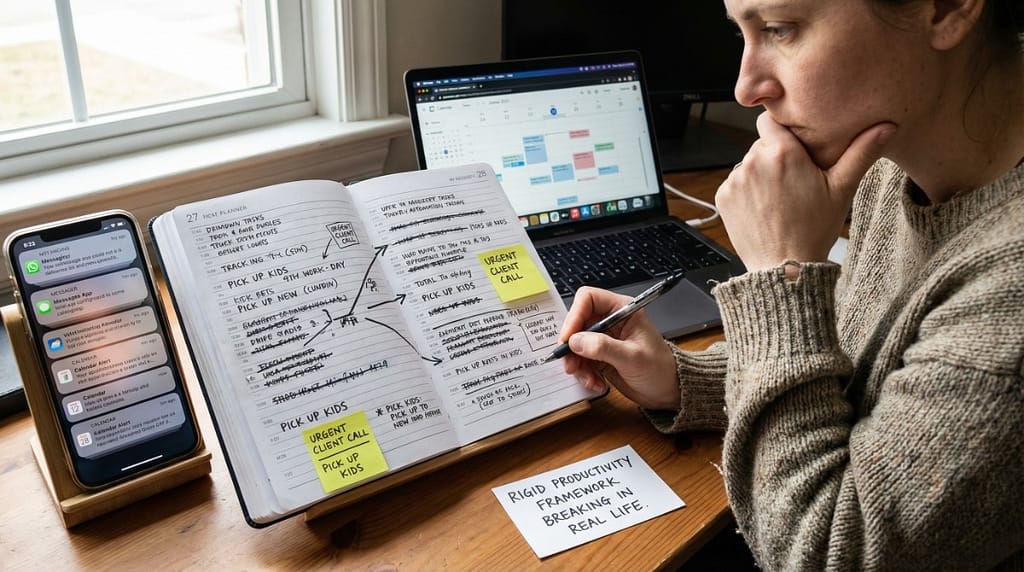
Productivity frameworks often look perfect on paper.
They promise structure, detailed planning, and efficient schedules. Everything feels organized and logical. You map out your day, assign tasks, and create clear systems designed to maximize output.
But real life rarely follows the plan.
Interruptions appear. Priorities shift. Energy drops. Unexpected tasks consume time you thought you controlled. And suddenly, the framework stops working.
The hidden issue isn’t your discipline. It’s the productivity frameworks flaw that many people never notice.
Why Productivity Frameworks Feel So Effective Initially
Structured systems create clarity. They tell you what to do and when to do it. That certainty reduces anxiety and gives the feeling of control.
In calm, predictable environments, these frameworks can work well. The problem appears when conditions change.
Most frameworks quietly assume:
- Stable schedules
- Consistent energy
- Few interruptions
- Perfect execution
When reality doesn’t match those assumptions, the system becomes fragile.
The Productivity Frameworks Flaw: Rigidity
A rigid framework works only when everything goes right.
If one task runs long, the schedule collapses. If an unexpected problem appears, the entire plan shifts. Instead of adapting, the system creates stress.
This fragility makes people believe they failed, when in reality the framework failed to account for life itself.
A true system survives disruption. A rigid plan breaks under it.
This issue closely relates to Why Productivity Advice Breaks Down in Real Life, where methods fail because they weren’t designed for unpredictable days.
Plans vs Systems
Many people confuse plans with systems.
A plan says:
- Do this at 9 AM
- Finish this by noon
- Follow this exact sequence
A system says:
- Prioritize outcomes over timing
- Continue even when interrupted
- Recover quickly after disruption
Plans depend on control. Systems depend on adaptability.
If your productivity method cannot absorb chaos, it’s only a plan.
Why Flexibility Creates Better Productivity
Flexible systems don’t require perfect days.
They allow:
- Tasks to move without guilt
- Smaller versions of progress
- Recovery after missed steps
- Changing priorities without collapse
Flexibility doesn’t reduce productivity. It protects it.
When expectations allow for imperfection, consistency improves. You spend less energy maintaining the framework and more energy doing meaningful work.
Building Systems That Survive Real Life
Strong productivity systems include:
- Buffer time for interruptions
- Clear priorities instead of rigid schedules
- Simple restart rules
- Focus on progress, not perfect execution
These elements make productivity sustainable.
The goal isn’t to eliminate disruption. It’s to design systems that continue despite it.
The Real Test of a Productivity System
Ask yourself:
- Does this still work on a bad day?
- Can I recover after missing tasks?
- Does the system adapt when priorities change?
If the answer is no, you don’t have a system yet.
You have a plan waiting for perfect conditions.
Productivity That Lasts
Real productivity often looks less impressive than highly structured frameworks.
It’s simpler. More flexible. Less rigid.
But it survives.
If your system only works when everything goes right, it isn’t a system at all. It’s a fragile plan dressed up as productivity.
FAQs
Why do productivity frameworks fail so often?
Because many assume stable, predictable conditions that rarely exist in real life.
Should productivity systems be flexible?
Yes. Flexibility allows systems to survive interruptions and changing priorities.
What’s the difference between a plan and a system?
A plan requires perfect execution; a system adapts and continues.
Affiliate Note
Deep Work is available on Amazon (USA) and Amazon (India) in multiple formats, including audiobook, Kindle, and print. It fits this topic because it highlights how focus systems must be designed intentionally to survive real-world distractions.