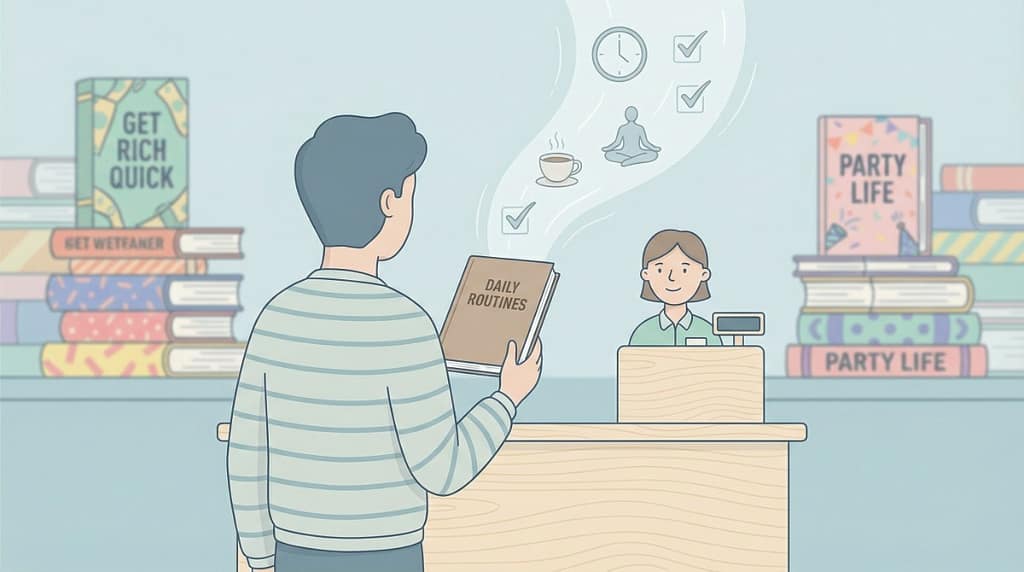
Buying books feels like progress. A new title promises insight, clarity, and change. The cover is convincing. The reviews are glowing. But most people have shelves full of unread or half-read books that never changed how they live. That’s why there is one question that matters before buying books.
Will this book change how I act?
If the answer is unclear, the purchase is likely driven by hope, not usefulness.
Information is easy to collect. Progress is not.
Why Information Alone Doesn’t Create Progress
Books are excellent at delivering ideas. They explain problems clearly and offer compelling perspectives. But information by itself does nothing.
Progress happens only when ideas influence decisions and routines. If reading doesn’t change what you do tomorrow, it won’t matter long term.
Many books promise insight, motivation, or inspiration. These feel valuable in the moment, but their impact fades quickly. Once the emotional lift disappears, behavior returns to normal.
This is why asking the right question upfront saves time and frustration.
The Question That Filters Useful Books
Before buying any book, ask:
Will this change how I act on a regular basis?
This question shifts the focus from curiosity to application. It forces you to think beyond how interesting the book sounds and toward how it fits into daily life.
A book is worth buying when:
- Its ideas translate into repeatable actions
- It influences routines, not just thoughts
- It helps you behave differently without needing constant motivation
If the book’s value depends on inspiration alone, its usefulness will be short-lived.
Inspiration Is Not a Strategy
Inspiration creates excitement. Strategy creates results.
Books that rely on emotional highs feel powerful at first. But once effort becomes difficult, inspiration fades. Without structure, habits collapse.
This is why many readers keep buying books but see little change. The problem isn’t the reader. It’s the criteria used to choose what to read.
This idea connects closely with How to Know If a Self-Help Book Is Worth Reading, which explains why behavior change is the real measure of value.
Look for Decision-Changing Ideas
The best books don’t overwhelm you with advice. They influence how you decide.
They simplify choices. Not only that, but they reduce friction. And they guide action when energy is low. Instead of asking you to try harder, they make the right behavior easier.
Before buying, look for signals:
- Does the book emphasize systems over motivation?
- Does it explain how ideas fit into real routines?
- Does it help you act even on bad days?
If yes, the book likely has lasting value.
Buying Fewer, Better Books
Not every book deserves your attention. Buying fewer books with higher practical value leads to better results than consuming everything that sounds appealing.
This approach saves:
- Time, by avoiding low-impact reads
- Energy, by reducing decision fatigue
- Frustration, by setting realistic expectations
The goal isn’t to read more. It’s to choose books that actually change behavior.
When buying books becomes intentional, reading turns from entertainment into progress.
FAQs
Why is this question so important before buying books?
Because it shifts focus from information to action, which is what creates real change.
Are inspirational books useless?
They can spark interest, but without structure, their impact fades quickly.
How can I tell if a book will change behavior?
Look for clear frameworks, repeatable actions, and routines that work without motivation.