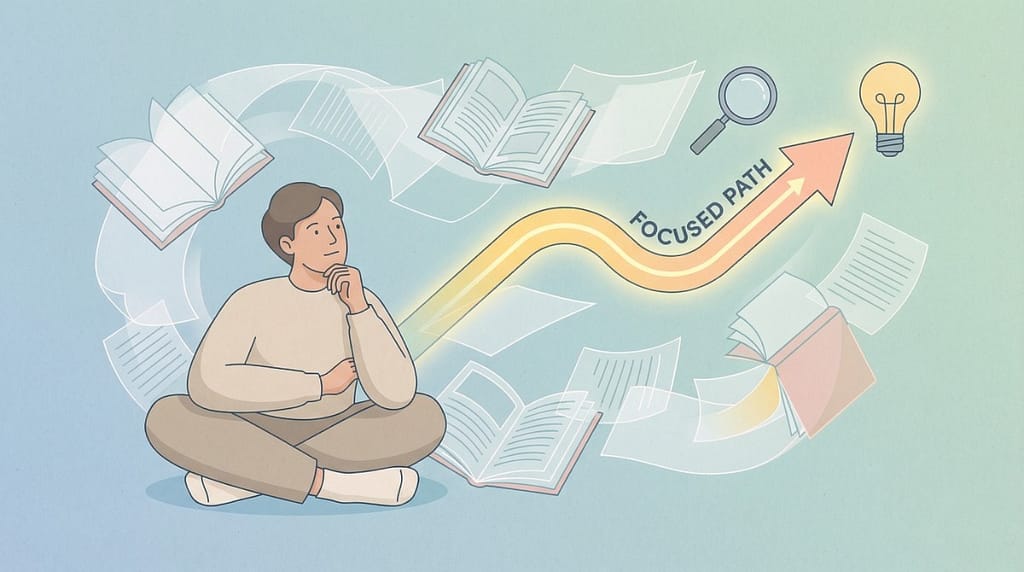
Reading more books feels productive. Each new idea adds input. Each finished chapter creates momentum. Over time, this creates the sense that progress must be happening. But for many people, nothing actually changes. That’s because reading without action creates activity without outcomes.
Information feels like movement, but it isn’t the same as execution.
When reading replaces action, it produces clarity without commitment. You feel informed but unchanged. And that gap is why reading more doesn’t fix your life.
Why Reading Feels Like Progress
Reading increases input. It fills the mind with explanations, frameworks, and language. This feels constructive because confusion temporarily disappears.
But reduced confusion is not the same as improved behavior.
Most readers stop at understanding. They collect insights instead of converting them into routines. Over time, reading becomes a substitute for doing—the mental version of staying busy.
This is why people can read constantly and still feel stuck.
Reading Without Action Creates Illusions
Progress depends on execution, not volume.
Reading helps only when it changes:
- What you decide
- What you remove
- What you repeat consistently
When none of those shift, reading turns into consumption. The brain feels rewarded, but behavior stays the same.
This is why people often say, “I know what to do, I just don’t do it.” Knowledge was never the problem. Application was.
This pattern is closely related to Why Reading More Books Doesn’t Mean You’re Growing, which explains how consumption can replace real change without delivering results.
Volume Is the Wrong Metric
Many readers measure success by how much they consume:
- Books per month
- Pages per day
- Notes collected
But volume doesn’t compound. Execution does.
One idea applied for weeks outperforms dozens of ideas skimmed once. Depth beats breadth when behavior is the goal.
Reading more books often increases mental noise. Reading fewer books, applied deeply, reduces confusion.
When Reading Becomes Distraction
Reading becomes a problem when it delays action.
Instead of starting, you search for better ideas. Instead of committing, you keep learning. Reading feels safe because it doesn’t demand risk, discomfort, or failure.
But growth requires all three.
If reading leaves your routines untouched, it’s not helping. It’s distracting.
Reading That Actually Works
Reading becomes useful when it supports execution.
That means:
- Reading with a specific behavior in mind
- Stopping once one idea is chosen
- Applying before consuming more
The goal of reading isn’t to feel informed. It’s to act with less friction.
Books should reduce confusion, not add to it.
Fewer Books, Clearer Direction
Real progress often starts when input decreases.
When you stop chasing more ideas, attention shifts to application. Action becomes simpler. Decisions become clearer.
Reading should narrow your focus, not scatter it.
If your life isn’t changing, the solution isn’t more reading. It’s less consumption and more execution.
FAQs
Why doesn’t reading more improve my life?
Because progress depends on action, not information volume.
Is reading useless then?
No. Reading works when it leads to behavior change.
How should I read for real progress?
Choose one idea, apply it consistently, and delay consuming more.
Affiliate Note
The Almanack of Naval Ravikant is available on Amazon (USA) and Amazon (India) in multiple formats, including audiobook, Kindle, and print. The audiobook works particularly well because the ideas are reflective and benefit from repeated listening rather than active note-taking.