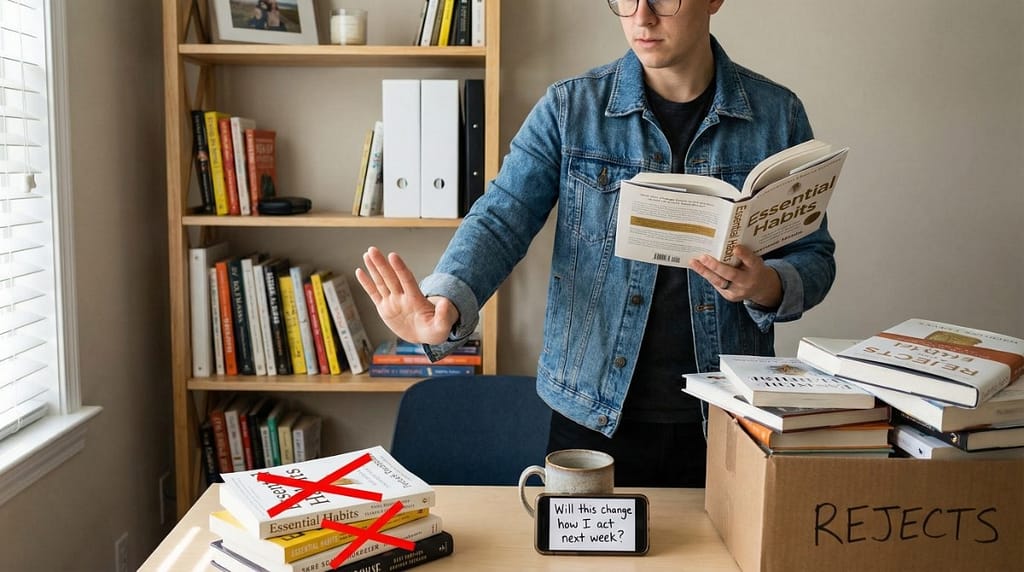
Most people don’t struggle to find books. They struggle to filter them.
Bookstores, recommendation lists, and social media are full of titles that sound intelligent and promising. Many of them are well written. But most still fail to produce change. The problem isn’t quality—it’s usefulness.
There is one simple question that instantly filters bad books:
Will this change how I act next week?
If the answer is unclear, the book is entertainment, not transformation.
Why Most Books Feel Useful but Don’t Work
Books often succeed at one thing: explaining ideas clearly.
Clarity feels productive. It removes confusion. It creates the sense that progress is happening. But clarity without action has no leverage. Nothing changes unless behavior changes.
That’s why people finish books feeling smarter but unchanged. The book delivered insight, but it never crossed into execution.
Filtering books by impact on action solves this problem before it starts.
A Bad Books Filter That Actually Works
A good filter doesn’t ask whether a book is popular or intelligent. It asks whether the book interferes with behavior.
The question “Will this change how I act next week?” forces specificity.
It immediately exposes weak books:
- Books that depend on motivation
- Books that sound insightful but stay abstract
- Books that promise mindset shifts without practical leverage
If you can’t identify a near-term behavior change, the book won’t earn your time.
Entertainment vs Transformation
There’s nothing wrong with entertainment. But entertainment should be chosen consciously.
Many books are enjoyable to read, quote-worthy, and intellectually satisfying. But they don’t reduce friction or influence decisions. They leave routines untouched.
Transformative books do the opposite. They:
- Reduce confusion
- Narrow choices
- Encourage decisive action
This distinction is closely related to If a Book Doesn’t Change This, It Won’t Change You, where decision-level impact determines real value.
Why This Question Saves Time and Money
Time is lost not by reading bad books, but by reading non-actionable ones.
When you apply this filter early:
- You stop buying books for reassurance
- You stop reading for vibes
- You stop collecting ideas without execution
Attention becomes selective. Reading becomes purposeful.
Fewer books, chosen well, outperform constant consumption.
How to Use the Question Practically
You don’t need to read the entire book to apply this filter.
Before buying or continuing, ask:
- What will I do differently next week?
- What decision will this influence?
- What will I remove or simplify?
If the book can’t answer these questions, pause. Move on. Let it go.
The best books don’t ask you to read more. They ask you to act differently.
Reading With Intention
Books are tools, not trophies.
When reading is guided by action, progress accelerates. When it’s guided by curiosity alone, growth stalls.
One clear question protects your time, money, and attention.
That question doesn’t make reading harder. It makes reading useful.
FAQs
Why do many books fail to create change?
Because they provide insight without influencing behavior.
Is this filter too strict?
No. It simply prioritizes action over entertainment.
Can a book still be useful later?
Yes. Timing matters. A book can be good but not useful right now.
Affiliate Note
How to Read a Book is available on Amazon (USA) and Amazon (India) in multiple formats, including audiobook, Kindle, and print. It pairs well with this idea because it teaches how to read selectively and extract only what leads to action.