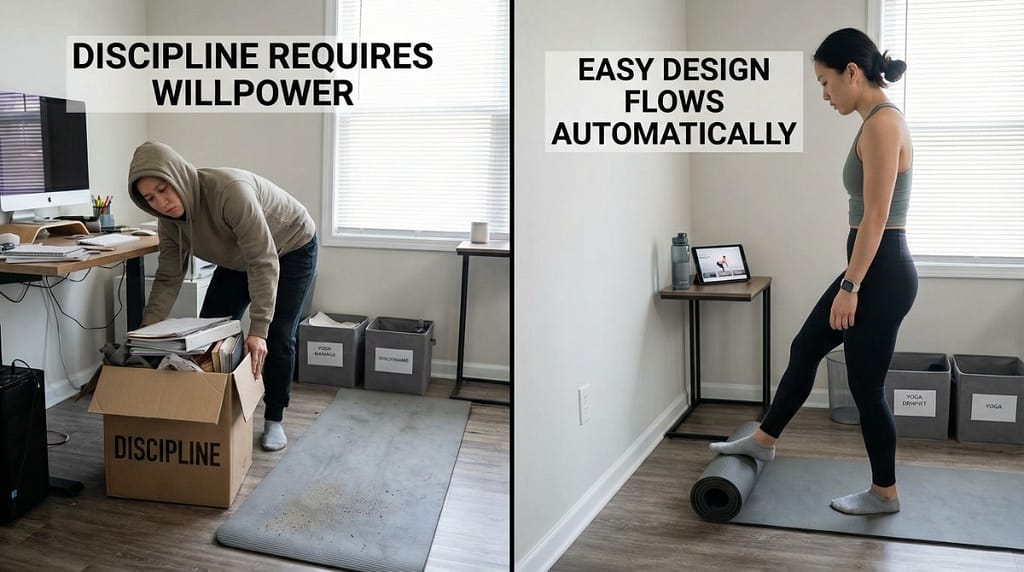
Discipline feels powerful.
It helps you start. It pushes you through resistance. It creates early momentum when motivation is high and goals feel exciting.
But discipline has limits.
It requires effort, and effort is expensive. When every action depends on willpower, habits begin to feel like constant decisions. Over time, that mental cost becomes exhausting. This is why many people struggle to maintain discipline long-term habits even after strong beginnings.
The issue isn’t commitment. The issue is relying on effort alone.
Why Discipline Works — But Only Temporarily
Discipline is useful at the beginning of any change.
It helps you:
- Start new routines
- Resist distractions
- Follow through before habits feel natural
The problem appears when discipline becomes the only engine.
Every day requires negotiation:
- Should I do it today?
- Do I feel like it?
- Can I push myself again?
When habits depend on repeated self-control, consistency eventually weakens.
Why Discipline Long-Term Habits Often Fail
Willpower doesn’t scale well.
Life introduces stress, fatigue, travel, illness, and unexpected responsibilities. On those days, discipline feels heavier than usual. If the habit has no support beyond effort, it collapses.
This is why people blame themselves when routines disappear. In reality, the system asked for too much energy.
Habits that feel like daily battles rarely survive long-term.
This pattern connects with Why Most Habit Advice Breaks After the First Disruption, where habits fail because they were never designed to recover easily.
The Hidden Cost of Constant Effort
Every decision consumes attention.
When a habit requires effort each time, mental fatigue builds quietly. Eventually, the brain chooses easier options—not because you’re weak, but because efficiency is natural.
Discipline-heavy habits create:
- Decision fatigue
- Emotional resistance
- Inconsistent follow-through
That friction makes progress unstable.
Habits Built on Design, Not Force
Strong habits shift the burden away from discipline and toward design.
Design means:
- Making the desired action easy to start
- Removing friction from good choices
- Making distractions harder to access
- Creating clear triggers in your environment
When the environment supports the behavior, effort decreases. The action becomes automatic instead of argumentative.
Systems reduce the need to “be strong.”
When Discipline Becomes Optional
The goal isn’t to eliminate discipline completely. It’s to use it briefly until structure takes over.
You know a habit is well designed when:
- You do it without debate
- Missing it feels unusual
- Energy level matters less
At that point, the environment and routine carry the behavior forward.
If a habit always feels like a fight, it will not last.
Building Habits That Survive Real Life
Ask yourself:
- Is this easy to start on a bad day?
- Does my environment encourage this action?
- What friction can I remove?
Small design changes often matter more than stronger effort.
Long-term consistency comes from reducing reliance on motivation and discipline—not increasing it.
The Real Role of Discipline
Discipline starts habits.
Design sustains them.
The strongest routines feel almost boring because they no longer require constant mental effort.
When the right action becomes easy, discipline quietly steps into the background — and habits finally become stable.
FAQs
Can discipline build habits by itself?
It can start them, but long-term consistency requires environmental support and design.
Why do disciplined routines collapse over time?
Because constant effort creates mental fatigue and decision overload.
How do you reduce reliance on discipline?
Make good actions easier and remove friction from starting.
Does needing discipline mean my habit system is weak?
Not always, but if every repetition feels difficult, it usually means the habit depends too much on effort instead of environment design. Strong systems reduce the amount of discipline needed over time.
Affiliate Note
Atomic Habits is available on Amazon (USA) and Amazon (India) in multiple formats, including audiobook, Kindle, and print. It fits this topic because it emphasizes environment design and systems that reduce reliance on willpower.