Introduction
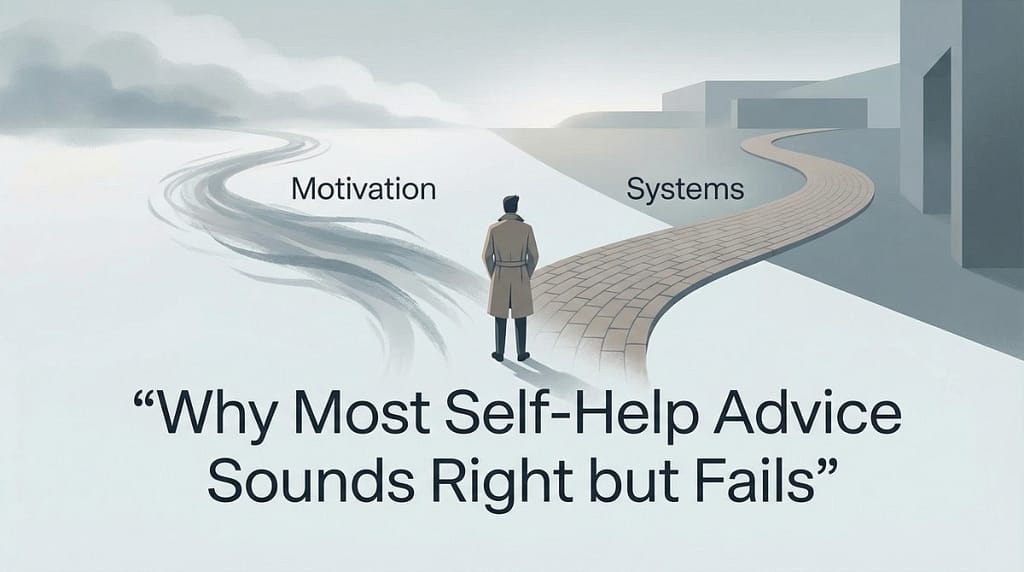
Most self-help advice fails not because people don’t try hard enough, but because the advice itself is designed to feel convincing rather than survive reality. It sounds right in the moment but collapses when pressure appears.
The real test of advice isn’t how inspiring it feels on a good day. It’s whether it still works on bad days, when motivation is low and conditions are messy.
Why Self-Help Advice Fails in Real Life
A large portion of self-help content relies on motivational language. This creates short-term emotional highs without changing the structures that shape behavior.
When advice ignores environment, habit design, and friction, it cannot hold up under real-world pressure. The moment stress, fatigue, or inconvenience appears, the advice stops working because nothing structural has changed.
Why Motivation Feels Powerful but Doesn’t Last
Motivation feels effective because it creates immediate clarity and energy. But that energy is unstable by nature.
Without systems to support action, motivation fades quickly. Advice that depends on constant enthusiasm requires ideal conditions—conditions that rarely exist consistently in real life.
Why Systems Outperform Inspiration Over Time
Sustainable growth comes from boring systems, not inspiring speeches. Systems reduce reliance on willpower by shaping behavior through structure.
When systems are designed well, progress continues even when motivation disappears. This is why advice that focuses on setup and friction works longer than advice that focuses on mindset alone.
This is also why ideas like Essentialism fail when people focus on motivation instead of structural change. “Essentialism Works Only If You Stop Doing This”
Conclusion
Advice that doesn’t survive bad days isn’t practical. Real change requires structures that function under pressure, not ideas that only feel good in theory. What lasts is not inspiration, but systems built for reality.
FAQs
Why does most self-help advice feel motivating but fail later?
Because it focuses on emotional uplift instead of structural change.
Is motivation useless for self-improvement?
No, but it’s unreliable without systems to support consistent action.
What makes advice practical in the real world?
Advice that accounts for environment, friction, and bad days tends to last longer.