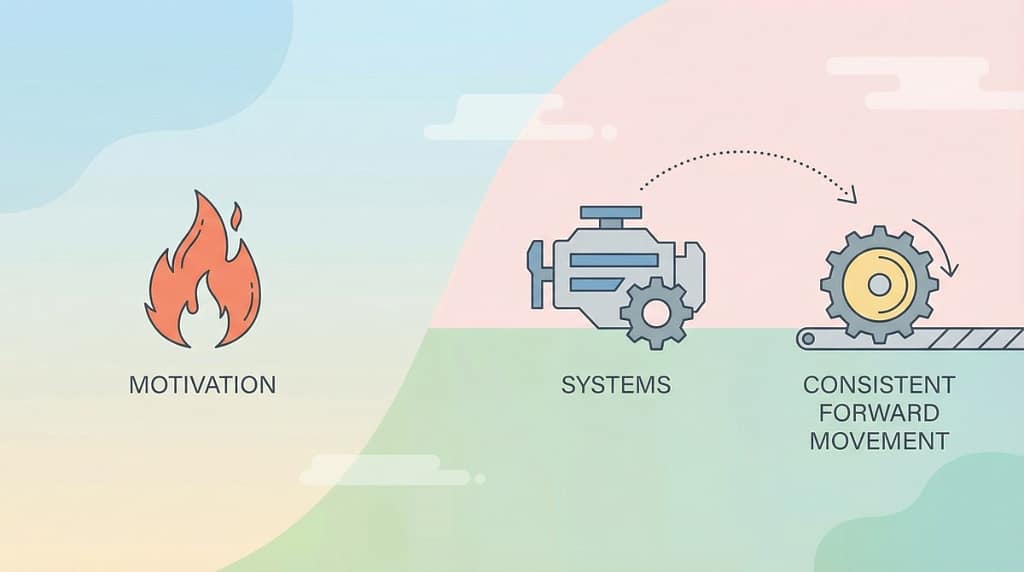
When progress stops, motivation is usually blamed. People say they “lost motivation” or “need more motivation” as if it were the missing engine. But motivation was never the engine in the first place. It’s temporary, emotional, and unreliable. Treating it as the main driver of progress is why so many efforts collapse.
Overused motivation has become the default explanation for failure, even when it doesn’t explain anything.
Progress doesn’t disappear because motivation vanished. It disappears because nothing was built to survive without it.
Why Motivation Feels Like the Problem
Motivation is easy to notice. You can feel it rise and fall. When energy is high, action feels effortless. When energy drops, everything feels heavy.
That emotional contrast makes motivation feel important. But importance isn’t the same as reliability.
Motivation spikes at the start of change—new goals, fresh plans, early excitement. It fades when repetition begins and difficulty shows up. That fade is normal, not a personal flaw.
Blaming motivation mistakes a symptom for a cause.
Overused Motivation vs Sustainable Progress
Motivation works like a spark. Systems work like an engine.
When progress depends on how you feel, it collapses under pressure. Bad days, stress, or distraction immediately derail action. When progress depends on structure, it survives emotional dips.
Systems reduce the number of decisions you need to make. They remove negotiation. They create default actions that don’t require enthusiasm.
This is why habits built on systems outlast motivation every time.
This pattern is also explained in Why Motivation Dies After Week One, where early excitement fades because nothing structural was designed to carry the behavior forward.
Decision Fatigue Is the Real Enemy
Every decision consumes energy.
When you rely on motivation, you’re asking yourself to decide—again and again—to do the hard thing. Over time, that decision cost becomes unbearable.
Systems solve this by deciding once and executing repeatedly.
- Fixed routines remove daily choices
- Clear triggers remove hesitation
- Simple rules remove debate
Motivation can start action, but systems keep it going.
Why Motivation Gets Overused
Motivation is comforting to blame. It feels internal and personal. If motivation is the problem, then success is just a feeling away.
Systems are less comforting. They require design, adjustment, and constraint. They force you to confront environment, routines, and trade-offs.
That’s why motivation stays the popular explanation—it avoids structural responsibility.
What Actually Sustains Progress
Progress survives when:
- Actions are small enough to repeat
- Routines are clear and predictable
- Friction is reduced
- The environment supports the behavior
None of these require high motivation. They require design.
When structure is in place, consistency becomes boring—and boring is exactly what lasts.
Stop Chasing the Wrong Fix
Motivation isn’t useless. It’s just limited.
Use it to start. Don’t expect it to sustain.
When progress stalls, the right question isn’t “How do I get motivated again?”
It’s “What structure is missing?”
Answer that, and progress continues—even on bad days.
FAQs
Why is motivation unreliable?
Because it’s emotional and fluctuates with stress, energy, and mood.
Does motivation matter at all?
Yes, but only as a trigger—not as a long-term strategy.
What replaces motivation for consistency?
Systems that reduce decisions and make action automatic.
Affiliate Note
The Motivation Myth is available on Amazon (USA) and Amazon (India) in multiple formats, including audiobook, Kindle, and print. The audiobook works particularly well because the ideas are conceptual and benefit from repeated listening rather than active note-taking.