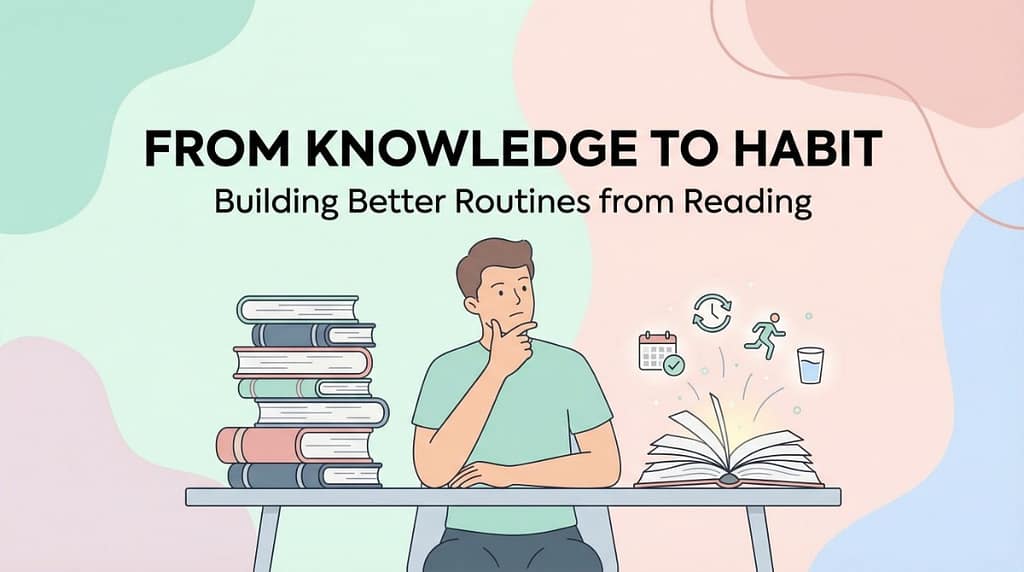
Reading has never been easier. Book summaries are everywhere, recommendations never stop, and finishing more books feels productive. But here’s the uncomfortable truth: reading more books doesn’t mean you’re growing.
Many people confuse consumption with progress. They assume that if they are constantly reading, they must be improving. In reality, most readers are simply collecting ideas without ever changing their behavior. Knowledge feels like movement, but without action, it produces no results.
Growth does not come from how many books you finish. It comes from what you do with the ideas you encounter.
Consumption Feels Like Progress—But Isn’t
Reading activates the brain. You feel engaged, stimulated, and informed. This creates a false sense of advancement. The problem is that intellectual stimulation is not the same as personal growth.
When reading becomes passive, it turns into entertainment disguised as self-improvement. You nod along, agree with insights, and move on to the next chapter — or the next book — without ever testing the idea in real life.
This is why many readers can quote dozens of books yet struggle to point to a single habit, decision, or outcome that changed because of them.
Why Reading for Growth Doesn’t Happen Automatically
The issue isn’t reading itself. The issue is how reading is used.
Growth requires friction. It demands effort, reflection, and repetition. Reading alone is frictionless. You can consume endlessly without ever being uncomfortable or challenged in practice.
Real progress happens when:
- One idea is selected
- The idea is applied consistently
- Behavior changes over time
Reading ten books on productivity without changing how you plan your day produces no growth. Applying one useful idea for 30 days does.
This is why fewer books, applied deeply, outperform dozens of books skimmed casually.
Reflection Is the Missing Step
Most readers skip the most important part: reflection.
Without pausing to ask “How does this apply to my life?”, ideas remain abstract. Reflection forces specificity. It turns general advice into personal action.
A simple test makes this clear:
- Can you name one behavior you changed because of a book?
- Can you point to one decision you now make differently?
If not, reading stayed at the surface.
This same mistake appears across self-help culture, which is why many people keep consuming advice but never feel progress. This idea connects closely with Why Reading More Books Doesn’t Mean You’re Growing as well as Why Atomic Habits Actually Works (When Other Books Don’t).
Growth Is Behavioral, Not Informational
Books don’t change lives. Behavior does.
Information only matters when it alters what you do daily. That’s why progress feels slow when growth is real. Habits take time. Implementation feels boring. Repetition lacks novelty.
But that is exactly where growth compounds.
Instead of asking, “What should I read next?”, better questions are:
- Which idea am I practicing right now?
- What behavior am I reinforcing this week?
- What result am I tracking?
Readers who grow focus on execution, not accumulation.
The Smarter Way to Read
Reading works best when treated as a tool, not a goal.
The purpose of a book is not to finish it. The purpose is to extract one idea worth acting on and build it into your life. Until behavior changes, growth hasn’t started.
If reading isn’t changing how you act, it’s not helping — no matter how many books you finish.
FAQs
Is reading for growth still important?
Yes, but growth only happens when ideas are applied consistently.
How many books should I read for growth?
As many as you can apply deeply. One applied book beats ten skimmed.
Why does reading feel productive without results?
Because learning creates mental stimulation without behavior change.